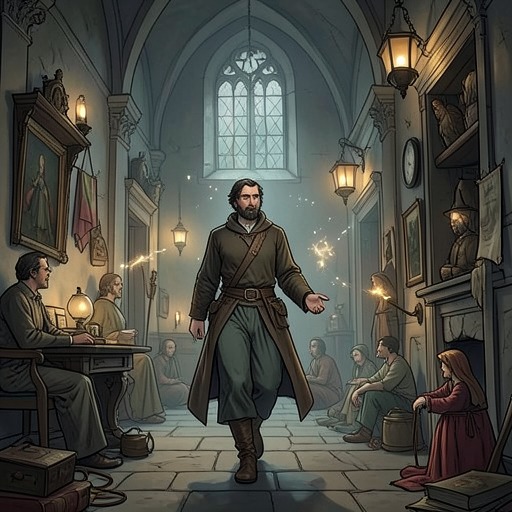
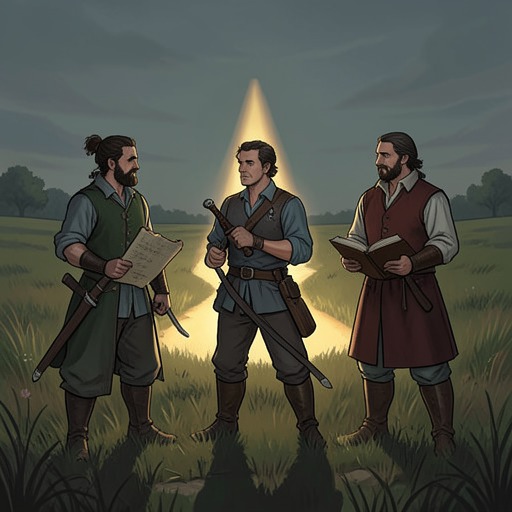
Csongor
Csongor és TündeCsongor, identified at the outset as a young hero, is defined by the journey that separates him from Tünde and by his persistence through its reversals. He crosses the world seeking her, and the play’s closing recognition transforms a long pursuit into rest beside the beloved he has sought.
Identity and Journey
Csongor’s designation as a young hero establishes him as the central human figure in a story that moves between ordinary and enchanted settings. His quest is not a settled passage from one place to another: its milestones include the three-way crossroads and the desolate landscape, where he appears amid Tünde and Ilma’s movements. These shifting settings make uncertainty part of the journey itself.
At the garden’s flowering fairy tree, Mirígy is bound beneath it when Csongor enters. The scene places him in a world where enchantment and its dangers are physically present, not merely distant objects of rumor. Later, the crossroads is explicitly associated with error, reinforcing how the route toward his goal repeatedly subjects him to misdirection.
Pursuit and Loss
Csongor’s travels do not bring immediate fulfillment. After one encounter, he laments that he has been terribly abandoned and speaks of the world of his fairy dreams; soon afterward, his departure is marked by the declaration that he has no peace and no life until his arms can attain what he seeks. His longing is therefore presented as an active force: separation does not turn him aside but renews his determination to continue.
The play repeatedly places him in motion while the object of his search remains elsewhere. Tünde and Ilma enter together in one episode, while Csongor is again introduced on his own much later. This separation of entrances makes the lovers’ parallel trajectories visible: the audience can follow their proximity in the larger plot even when Csongor cannot reach Tünde.
Reunion and Significance
Near the end, Csongor enters once more, still bearing the weight of desire. Tünde then approaches alone, and recognition breaks through the distance that has governed the journey. Csongor identifies her with astonishment and, after so much suffering, finds rest in her embrace. The ending answers his earlier declaration of unrest with an image of repose, bringing the quest to its emotional conclusion.
Csongor’s narrative role rests on this contrast between restless pursuit and final recognition. The three-way crossroads, the repeated departures, and his return to the stage before Tünde’s appearance all prolong the interval between desire and fulfillment. The reunion matters not simply as arrival at a destination, but as the reversal of the abandonment that had made the journey necessary.